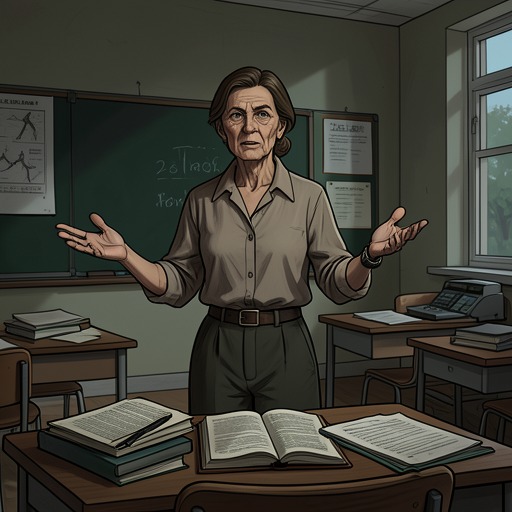
Donald Whitcomb
The World According to GarpDonald Whitcomb is a young teacher in the English Department at Steering School whose chance meeting with T. S. Garp, shortly before Garp’s death, shapes his life and his later work as Garp’s biographer. Whitcomb listens as Garp describes fiction as an effort to keep people alive, writes down the exchange, and ultimately becomes the meek, trusted custodian of the Garp family’s literary record. His recollections preserve Garp’s thoughts while revealing how memory, devotion, and a biographer’s dependence on his sources shape the story of a life.
Identity and First Meeting
Whitcomb is a young man fresh out of graduate school, newly teaching in the English Department at Steering School. He admires Garp’s writing, and his nervous stutter reminds Garp affectionately of Mr. Tinch. Garp is eager to talk about writing; Whitcomb is eager to listen. Their conversation takes place over Garp’s customary modest lunch at Buster’s Snack and Grill: tea with honey, one tangerine, and one banana. The ordinary setting gives way to a compact lesson in the novelist’s work.
Garp tells Whitcomb that beginning a novel feels first like trying to make the dead come alive, then corrects himself: it is more like trying to keep everyone alive forever, including those who must die at the end. He settles on the formulation, “A novelist is a doctor who sees only terminal cases,” and Whitcomb is so impressed that he writes it down. The exchange gives Whitcomb a durable statement of Garp’s artistic imagination: fiction cannot abolish death, but it can preserve the lives that death will take.
Encounter with Garp’s Final Day
Whitcomb’s first conversation with Garp becomes inseparable from the day’s turn toward loss. Garp leaves the restaurant for wrestling practice, and Whitcomb returns to his small apartment in a dormitory, trying to record everything that impressed him. He has to stop before finishing, in time for supper. When he heads to the dining hall, he is among the few at Steering School who have not yet heard what has happened.
Dean Bodger stops him before he enters. Bodger’s eyes are red-rimmed, his face looks suddenly years older, and he is clutching Garp’s ski hat in his cold hands—the hat he had said he would bring to Garp at the gym. Seeing that Bodger still has it, Whitcomb understands that something is wrong even before he looks into the dean’s eyes. The unfinished notes and the recovered hat mark two forms of interruption: Whitcomb’s attempt to record his meeting is cut short, and Garp’s ordinary passage from lunch to practice has become a final one.
The Biographer and His Sources
Years later, Whitcomb’s biography is the work other would-be biographers envy and resent. He becomes Garp’s scholar and, in the narrative’s words, the final authority on him. Helen trusts Whitcomb with the family and literary record, and she reads all but the biography’s last chapter, which he postpones for years before writing as her eulogy. Whitcomb’s role thus extends beyond collecting Garp’s words: he is entrusted with the story of the family that outlives its central writer.
The confidence Helen places in Whitcomb is personal as well as archival. He is a lifelong monkish recluse who spends much of his life in virtual hiding at Steering School, and he is fortunate both to discover Garp shortly before his death and to be befriended and looked after by Helen. Helen believes Whitcomb may adore her husband even more uncritically than she does. Duncan jokes that Whitcomb has the proper meekness for a biographer; the joke points to the disposition that makes him acceptable to the family, but also to the limits of his independence as an interpreter.
Whitcomb believes what Helen tells him, including every note she says Garp left. That qualification matters: the record he preserves is not simply a transparent collection of Garp’s own documents, since some of its contents reach Whitcomb through Helen’s account. His loyalty gives the family a sympathetic biographer, while making the biography’s evidentiary foundation dependent on the testimony of the widow whose life it will eventually honor.
Memory, Mortality, and Narrative Role
Whitcomb’s account gives a name to a late flowering of Garp’s writing: he calls it the Bloom Period. He attributes its urgency to Garp’s sense of mortality, arguing that the attempted assassination by an Ellen Jamesian in a dirty-white Saab gave Garp the impetus to write again. Helen endorses Whitcomb’s interpretation. The account is plausible, though the narration observes that Garp would surely have laughed at it: he had forgotten the Ellen Jamesians and was not watching for more. The possibility remains that the urgency Whitcomb identifies was present unconsciously, rather than as a conscious response to the attack.
The contrast between Whitcomb’s retrospective explanation and Garp’s own reported indifference keeps the biography from becoming a simple account of cause and effect. Whitcomb can interpret a renewed period of writing through the danger Garp survived, but the text also leaves room for motives Garp himself did not recognize—or would not have accepted. His later authority therefore rests not on perfect access to Garp’s intentions but on sustained attention, memory, and Helen’s trust.
Whitcomb’s appearance and manner become almost fixed in memory: he is always called “the young Whitcomb,” though he does not remain young; his face never grows a beard, his cheeks stay pink beneath hair that turns brown, then gray, then frost-white, and his voice remains a stuttering, eager yodel. His hands, too, are remembered as forever wringing themselves. This portrait makes his lasting identity less a matter of outward change than of enduring eagerness and reticence. He loves Garp even at his most whimsical and pretentious, and becomes the keeper of a life whose ending, as Garp writes, leaves memory behind. Whitcomb’s biography is his answer to that remainder: an act of preservation that honors its subject while carrying the unmistakable imprint of the people who survived him.